WhatsApp Statistics 2026: Official Numbers from Meta
WhatsApp statistics for 2026, each linked to Meta or WhatsApp: 3 billion users, 2 billion daily actives, business messaging, AI agents and ecommerce results.
 Nicolas ProvostAug 3, 2026 · 9 min read
Summarize this article with an AI
 ChatGPT
 Claude
Table of contents (10)
Key takeaways
- More than 3 billion people in over 180 countries use WhatsApp, and Meta counts more than 2 billion daily actives.
- Paid messaging within WhatsApp crossed a $2 billion annual run-rate in Q4 2025, and more than 1 million businesses used Meta Business Agents every week by July 2026.
- In a Meta case study, the retailer Magalu reports a 3X higher conversion rate on WhatsApp than on its app and ecommerce site over six weeks.
- No independent benchmark exists for WhatsApp marketing open rates, so track read, reply and opt-out rates in your own account.
Quick answer
The figures you can check at the source: more than 3 billion people in over 180 countries use WhatsApp (WhatsApp), WhatsApp has more than 2 billion daily actives (Meta, Q4 2025 earnings call), it peaked at 30 million messages sent per second in July 2026 (Meta, Q2 2026 earnings call), paid messaging within WhatsApp crossed a $2 billion annual run-rate in Q4 2025, and the WhatsApp Business app had more than 200 million monthly users in July 2023 (Meta, Q2 2023 earnings call). Every statistic below links to the document it comes from.
A note on method: Meta shares WhatsApp figures irregularly, mostly in earnings calls, on WhatsApp's own site and in the case studies it publishes. This page lists figures published by WhatsApp or Meta, dated when the source gives a date, plus one email benchmark published by Mailchimp and labelled as such. All sources were reread on October 24, 2026. Numbers we could not trace to a primary source (users by country, daily messages, business accounts, open rates) are left out.
Users and Reach
- More than 3 billion people in over 180 countries use WhatsApp, according to WhatsApp's About page.
- More than 2 billion daily actives on WhatsApp, according to Meta's Q4 2025 earnings call (January 28, 2026).
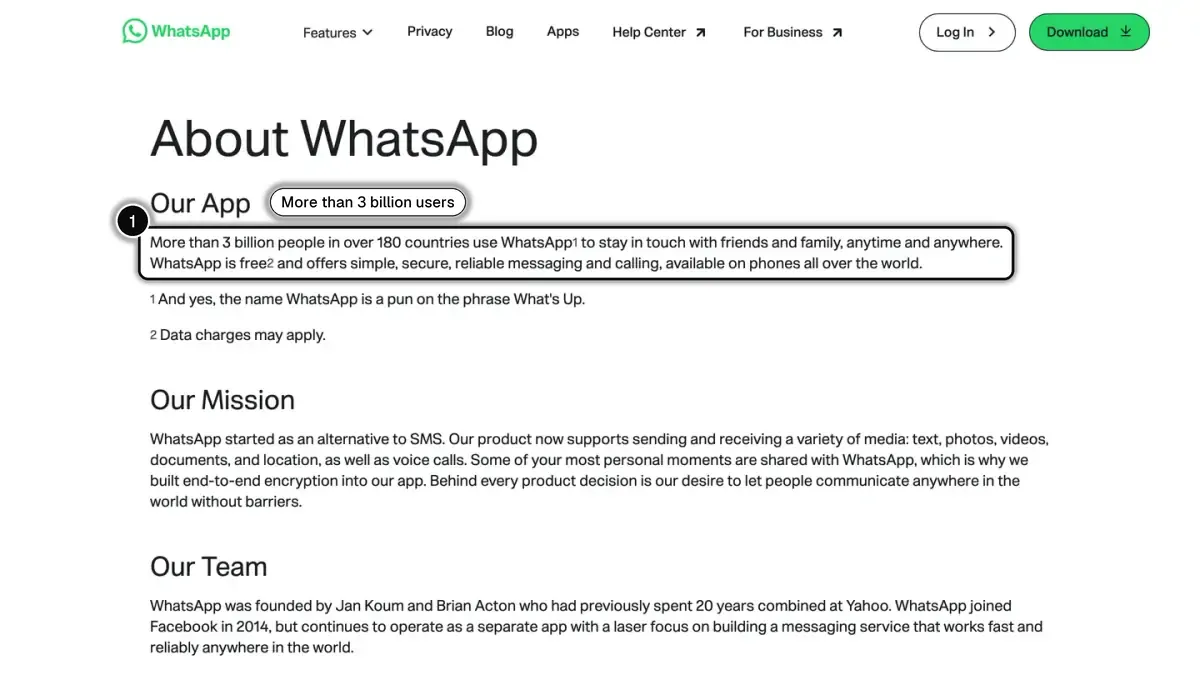
Source: WhatsApp, About page, read on October 24, 2026.
Engagement
- 30 million messages per second: in July 2026, Meta said WhatsApp had just hit an all-time messaging record, peaking at 30 million messages sent per second during the World Cup Final (Q2 2026 earnings call, July 29, 2026).
- Meta's 2026 earnings calls do not give a daily message total, and the daily figures that circulate for 2026 are third-party estimates, so we do not list them.
- For a brand, what matters is whether your own messages get read and answered. Track read rate (messages read divided by messages delivered) and reply rate per campaign: they tell you more about your WhatsApp marketing than any global total.
Business and API
- More than 200 million monthly users of the WhatsApp Business app in July 2023, according to Meta's Q2 2023 earnings call (July 26, 2023). This counts users of the app, not distinct businesses.
- A $2 billion annual run-rate crossed by paid messaging within WhatsApp in Q4 2025, according to Meta's Q4 2025 earnings call (January 28, 2026). Paid messaging is what businesses pay Meta per delivered message on the API: our WhatsApp Business pricing guide explains the rates.
- $1 billion of quarterly "other revenue" for Meta's Family of Apps, reached for the first time in Q2 2026 and up 73% year over year, driven primarily by WhatsApp paid messaging and subscriptions revenue, according to Meta's Q2 2026 earnings call. On its Q4 2025 call, Meta named Meta Verified subscriptions among the drivers of that revenue line: Meta Verified is the paid plan behind the WhatsApp verified badge in the Business app.
- There is no independent public benchmark for WhatsApp marketing open rates; vendor figures are not audited. Measure read rate, click rate and opt-outs in your own account.
- Meta limits marketing templates per user. WhatsApp may cap how many marketing templates a person receives from all businesses, based on that person's recent engagement, and it does not currently deliver marketing templates to US phone numbers (Meta's per-user marketing limits page, updated June 17, 2026). Our Black Friday playbook covers how to plan sends around the caps.
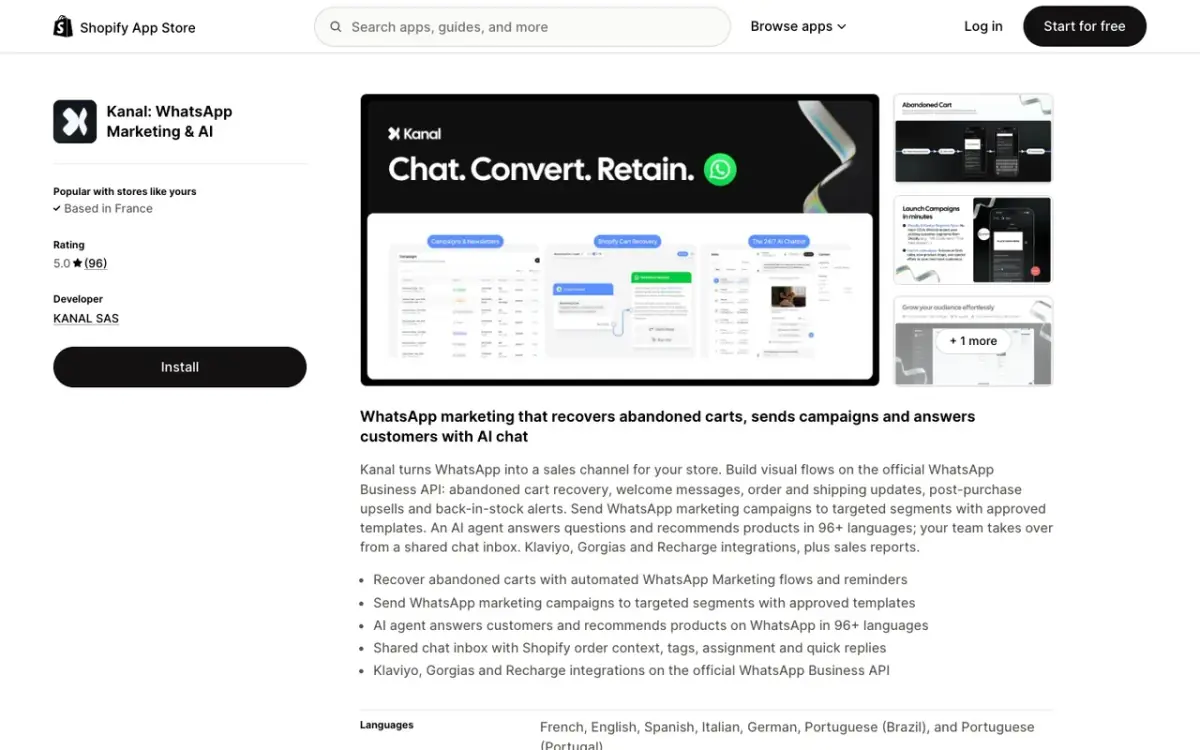
- Businesses using the official WhatsApp Business API get pre-approved templates, quality ratings per number and progressive sending limits, which is what platforms like Kanal run on.
WhatsApp ecommerce statistics
These figures come from case studies Meta publishes on its WhatsApp Business site and from Meta's earnings calls. Meta labels its case study results as self-reported, so read them as examples, not averages.
- 3X higher conversion rate than Magalu's app and ecommerce site: the Brazilian retailer built a shopping experience inside WhatsApp, with an AI shopping assistant, card carousels, WhatsApp Flows and payments on WhatsApp, measured from October 21 to December 3, 2025 (Meta, Magalu success story).
- 75% of Magalu's payments in that experience were made with the Pix copy-and-paste feature enabled by payments on WhatsApp (same source).
- 10% of customer service interactions: Mercedes-AMG PETRONAS F1 Team set a goal for WhatsApp to handle that share of the customer service for its ecommerce store, and says it surpassed it within a few months of launch (Meta, Mercedes-AMG PETRONAS F1 Team success story).
- More than 50% year-over-year growth in US click-to-message ads revenue in Q4 2025, driven by Website to Message ads, which send people to a business's website before they start a chat, according to Meta's Q4 2025 earnings call.
- More than 1 million businesses used Meta Business Agents every week to talk to their customers or complete sales, after Meta made them available globally on WhatsApp and Messenger, according to Meta's Q2 2026 earnings call (July 29, 2026).
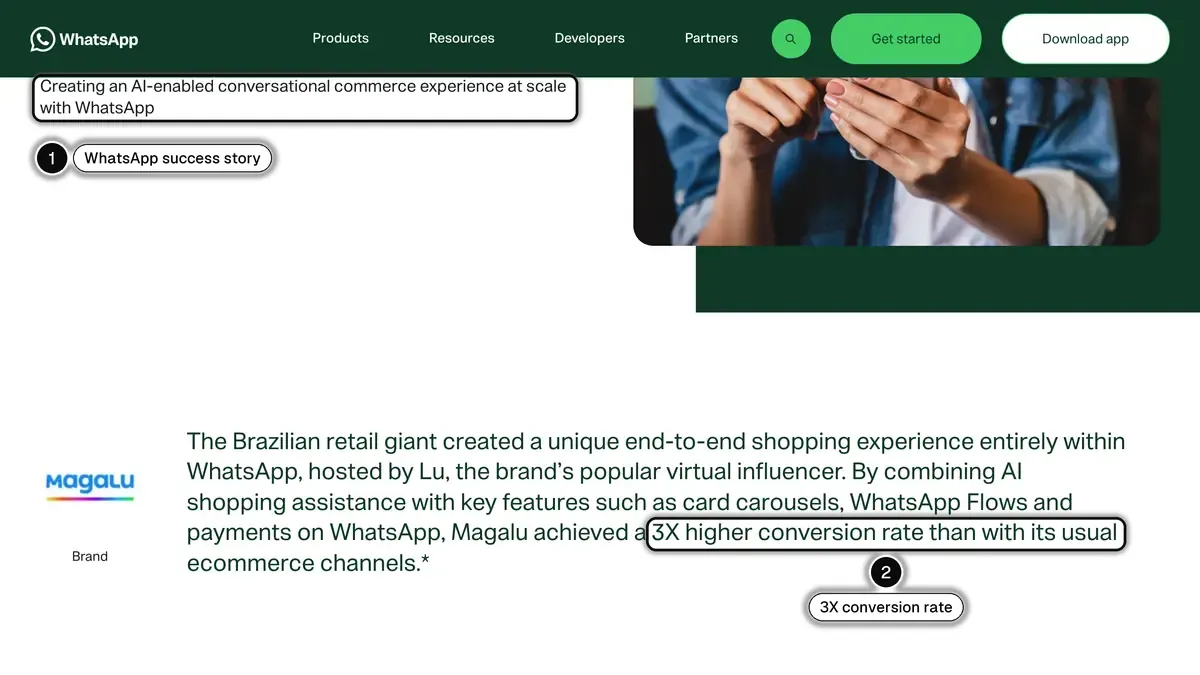
Source: Meta, WhatsApp Business success story "Magalu", read on October 24, 2026. Meta notes that the results are self-reported.
What this means for a Shopify store: the same building blocks are available to smaller brands. Cart reminders, order updates and an AI agent that answers product questions are the usual first steps: see abandoned cart recovery on WhatsApp, WhatsApp order notifications and Kanal's WhatsApp AI agent. Measure the recovery rate against your email flow on the same carts, with a holdout group.
WhatsApp marketing statistics: ads, paid messaging and AI agents
These figures come from Meta's earnings call transcripts, reread on October 24, 2026.
- A $10 billion revenue run-rate for click-to-message ads, ads that open a chat in Messenger, Instagram or WhatsApp, as Meta restated on its Q1 2023 earnings call (April 26, 2023). The figure covers all three apps, not WhatsApp alone.
- 40% quarter-over-quarter growth in the number of businesses using paid messaging on WhatsApp, according to the same Q1 2023 call.
- Over 80% year-over-year growth in daily click-to-WhatsApp ads revenue, as Meta said on its Q2 2023 earnings call (July 26, 2023). Our click-to-WhatsApp ads benchmarks explain how to measure these ads on your own account.
- More than 10 million conversations each week facilitated through Meta's Business AIs, up from 1 million at the start of the year, according to Meta's Q1 2026 earnings call (April 29, 2026). Meta gives this figure for its messaging platforms as a whole, not for WhatsApp alone.
- Usernames are rolling out gradually, and you can reserve one in the meantime, according to WhatsApp's Help Center. See our WhatsApp usernames guide.
For email, a public reference point exists: Mailchimp's email marketing benchmarks (read on October 24, 2026, based on data available in December 2023) put the average open rate at 35.63% and the click rate at 2.62% across all users, and at 29.81% and 1.74% for e-commerce. We have not found an equivalent primary source for WhatsApp marketing, and an email open is not measured the same way as a WhatsApp read, so compare each channel with its own history.
France and Europe
Country-level WhatsApp user counts for France and other European markets are estimates we could not trace to a primary source, so this page does not list them. For a store selling in Europe, the useful numbers are your own: the share of customers who opt in to WhatsApp through your pop-up, widget or QR codes, by country, and how WhatsApp reminders perform against email on the same carts.
The Numbers to Track on Your Own Account
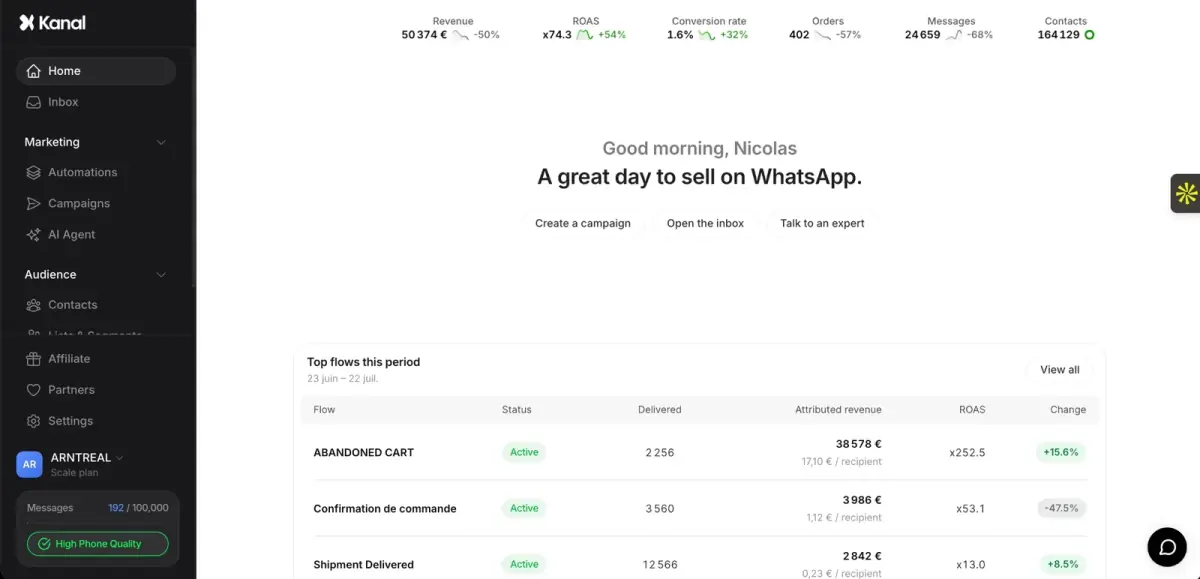
Global figures show the size of the channel; your own figures tell you whether it works for your store. Track these per campaign and per flow:
- Opt-in rate: customers who opt in to WhatsApp divided by customers asked (pop-up, widget, QR code, post-purchase message).
- Delivery rate: messages delivered divided by messages sent.
- Read rate: messages read divided by messages delivered.
- Reply rate: replies divided by messages delivered.
- Revenue per message: attributed revenue divided by messages delivered.
- Opt-out rate: opt-outs divided by messages delivered, read together with your number's quality rating.
Keep the definitions fixed, record a baseline over your first weeks, and use a holdout group to measure what WhatsApp adds. Our WhatsApp marketing ROI and KPIs guide goes further into conversion, ROI and ad metrics.
How to cite these statistics
Feel free to cite this page. If you use a statistic, please link to this page or to the primary source given next to each number. This page is updated as WhatsApp and Meta publish new official figures; the "last updated" date in the header reflects the latest revision.
Sources
- WhatsApp: About
- Meta Q1 2023 earnings call transcript
- Meta Q2 2023 earnings call transcript
- Meta Q4 2025 earnings call transcript
- Meta Q1 2026 earnings call transcript
- Meta Q2 2026 earnings call transcript
- Meta: Magalu success story and Mercedes-AMG PETRONAS F1 Team success story
- Meta: per-user marketing template limits
- WhatsApp Help Center: contact someone by username
- Mailchimp email marketing benchmarks
See Kanal on your own store
- Your campaigns and cart reminders on WhatsApp, starting from your own store
- Post-purchase offers, back-in-stock alerts, then the AI agent that advises your customers
- You leave with the plan that fits and its price
From €89/month
- brands
- 500+
- to set up
- 5 min
- open rate on WhatsApp
- +90%
Nicolas helps e-commerce brands grow revenue with WhatsApp marketing. With deep expertise in Shopify ecosystems and conversational commerce, he shares proven strategies for abandoned cart recovery, broadcast campaigns, and AI-powered customer engagement.